
Valley Forge
Even though no battle was fought at Valley Forge it was a turning point in the Revolution
The Continental Army arrived at Valley Forge on December 19, 1777 after several battles with the British. Since fall troops had problems with their supplies. In winter the problems became worse, a shortage of food happened and now soldiers received irregular supplies of meat and bread. These shortages forced the men to look for food in the forests and farm fields.
Conditions were so severe that General Washington wrote, "that unless some great and capital change suddenly takes place... this Army must inevitably... starve, dissolve, or disperse, in order to obtain subsistence in the best manner they can." Feeding the 12,000 men at the encampment was only one of the problems. Washington also was having problems getting support from Congress. There were threats to his leadership. His officers were unhappy and he needed to better prepare the troops to meet the enemy in the coming campaign.
Another problem was clothing. Long marches had destroyed the troop shoes, they had few blankets, only some garments were replaced. At one point, these shortages caused nearly 4,000 men to be listed as "unfit for duty." Washington asked the Congress for help but it was not available and the soldiers continued to suffer. Wives, sisters, and daughters of the enlisted men tried provided some of the needed services such as laundry and nursing care.
In March things looked brighter, food and supplies started coming in. By April Baron von Steuben began to transform the bare hungry troops into a fighting force. In May French allied with the colonists, and with it military and financial support from France.
Six months after they arrived to Valley Forge a renewed army went towards Ney Jersey for their next battle against the British.
People who served at Valley Forge: Benedict Arnold, Nathanael Greene, Alexander Hamilton, Lafayette, James Monroe, Baron Von Steuben, Martha Washington, "Mad" Anthony Wayne, and others. Plus special reports on the officers, regiments, and surgeons who served.

The Continental Army arrived at Valley Forge on December 19, 1777 after several battles with the British. Since fall troops had problems with their supplies. In winter the problems became worse, a shortage of food happened and now soldiers received irregular supplies of meat and bread. These shortages forced the men to look for food in the forests and farm fields.
Conditions were so severe that General Washington wrote, "that unless some great and capital change suddenly takes place... this Army must inevitably... starve, dissolve, or disperse, in order to obtain subsistence in the best manner they can." Feeding the 12,000 men at the encampment was only one of the problems. Washington also was having problems getting support from Congress. There were threats to his leadership. His officers were unhappy and he needed to better prepare the troops to meet the enemy in the coming campaign.
Another problem was clothing. Long marches had destroyed the troop shoes, they had few blankets, only some garments were replaced. At one point, these shortages caused nearly 4,000 men to be listed as "unfit for duty." Washington asked the Congress for help but it was not available and the soldiers continued to suffer. Wives, sisters, and daughters of the enlisted men tried provided some of the needed services such as laundry and nursing care.
In March things looked brighter, food and supplies started coming in. By April Baron von Steuben began to transform the bare hungry troops into a fighting force. In May French allied with the colonists, and with it military and financial support from France.
Six months after they arrived to Valley Forge a renewed army went towards Ney Jersey for their next battle against the British.
People who served at Valley Forge: Benedict Arnold, Nathanael Greene, Alexander Hamilton, Lafayette, James Monroe, Baron Von Steuben, Martha Washington, "Mad" Anthony Wayne, and others. Plus special reports on the officers, regiments, and surgeons who served.

Battle of Saratoga
martes, 15 de marzo de 2011
 The Battle of Saratoga is one of the most important battles fought during the war of the American Revolution.
 In the year of 1776 the Continental Army had won the battles of Trenton and Princeton. These two victories gave them strength to continue fighting for their liberty. During this time the British had captured New York and it was under Royal Garrison´s control. As the will of the British to stop the Patriots they created a plan.
The British plan was to come from Canada and enter through New York to take control of Albany, New York. They had the idea that if they controlled one part of the Hudson River and the New York City then it will very easy to control the whole Hudson River.
 As the British army arrived the Americans were already on their positions and block the path to Albany. The tactic the Continental Army used in this battle was Bemis Height. This consisted on putting cannons on heights. They represented a danger to the British Army. During this battle the continental army had another commander who was General Horatio Gates. The British army attacked in lines but it was impossible to pass through the Americans. As the day passed some German troops came to help the British but it was too late they had suffer a lot of losses. This happened in September 19, 1777.
 As the battle went through in October 7 the British were running out of supplies and ammunitions. The British did a one last attack but without any result so they withdraw. They had not got so far when at the gates of Saratoga they were surrender by the Americans.
As the Americans won the Battle of Saratoga everything turned on their favor. The French made a public alliance with the patriot and they gave them balance to the war. This means that the Patriot had as many opportunities to win the war as the British.
Everything can turn in the best way if we learn how to handle the situations that we are passing through.
British Army vs. Continental Army
The British face the Patriots in the battles fought during the American Revolution. No one thought that the Continental Army could defeat the most powerful army of Europe.
 The British were a well trained army. They had many cannons, bayonets, supplies of food and provisions. This army had all the material they need to win the war. The British didn´t saw the Patriots as a strong army that could defeat them.
The British were a well trained army. They had many cannons, bayonets, supplies of food and provisions. This army had all the material they need to win the war. The British didn´t saw the Patriots as a strong army that could defeat them. 
By the other hand the Continental army lack of all the supplies the British enjoyed. They lack food, clothe, shoes, arms and ammunitions. These soldiers passed through harsh times but their will to be free was stronger than any other thing. An important advantage the Continental army had was that it was guide by George Washington. He planned everything very well and his biggest ideal was to protect his army, this is how the tactic of “protracted war” emerged. This is one reason why the Continental Army resisted for so long.
The biggest difference among these two groups was that the Continental Army fought for freedom and they will never give up until they had accomplished their ideal or died while they had tried. While the British only fought to regain the power they had lost over the colonies. This show us that everything we do from our heart and in the best way we can there’s nothing that can stop us until we had accomplished this ideal.

Continental Army
Declaring Independence
viernes, 25 de febrero de 2011
Two motives sparked the American Revolution:
First colonists were outraged because British officials hired the services of foreign soldiers called “Hessian”. They were outraged for that because Britain was hiring outsiders to do the killing for them.
The second motive was because of Thomas Paine. He was a newly arrived immigrant to the colonists and with the help of Benjamin Franklin got a job at the Philadelphia magazine. On January 10 he anonymously published a pamphlet called “Common Sense” in which he wrote his views on the need of American Independence. The pamphlet sold 120,000 copies within a few months, and eventually sold 500,000 copies, or one for every five people in America, including slaves. Paine gave all the money earned with his pamphlet to the Congress, as a sign of patriotism.
On June 7, 1776 Richard Henry Lee, a Virginian, said that the colonies “are, and of a right ought to be, free and independent states.” Few days later a committee was appointed to draft a formal declaration.
 The committee consisted of Benjamin Franklin, John Adams, Roger Sherman, Robert Livingston, and Thomas Jefferson. Jefferson was selected as the writer for three reasons according to Adams: First, he was a Virginian; Second: he was very recognized and popular; Third, he wrote fluently. Few weeks later Jefferson finished a document that will become recognized as one of the most eloquent political statements, although some of the grievances were exaggerated and he declared all men were equal when many other Americans owed slaves and didn’t saw them as equal. The document was presented on Congress in June 28.
On July 2, 1776 Congress voted and decided America was free.
On July 4, 1776 the Congress formally adopted the Declaration of Independence.
Patriots Vs. Loyalists
The American Colonies were divided into the Patriots and Loyalists during the Revolutionary times.
Loyalists
 Loyalists were the American colonists who remained loyal to Britain. They were often referred as the Tories, Royalists, or Kings Men by the Patriots. Many of them were older wealthy merchants who belong to the Church of England. Fifteen to twenty percent of white populations were Loyalists. The most number of loyalists were found in the Middle Colonies. Most of Pennsylvania Dutch were Loyalists because they feared the lands that were given to them by the royalty will be in danger with a republican form of government. They thought resistance to the Crown was morally wrong. Most loyalists were passive and waited London to send armies to suppress the rebellion. Patriots would insult Loyalists because they didn’t believe in the Patriots causes. About 100,000 loyalists left the country after the Revolution.
Loyalist Argument
- Common Heritage and Culture with England
- Benefit from the trans-Atlantic trade
- Many were first generation or had close relatives in England
- Strong sense of duty to British Crown
- Farms and Farm products could be greatly reduced in value
- Separate government could become an anarchy
- They thought actions taken by revolutionary committees were illegal

Patriots

Patriots were also called Whigs or Americans Most Patriots were highly educated but many ordinary men and women supported and aided the Patriot cause. The middle and lower classes didn’t like the economic situation mainly due to British taxation. They believed British taxes were illegal because the colonists were not directly represented in Parliament. Patriots fought to end the power and control Britain had over the Colonists and by doing this eventually they gained Independence from Britain. Patriots’ goal was to defend American rights and preserve the principles of republicanism by rejecting monarchy and aristocracy.
Patriot Argument
- Individual liberty was threatened by greater government
- A series of acts and laws passed by the British Government were oppressive and indicative of a decline in colonial rights.
- No representation in British Parliament
- The Quartering of British troops
- Closing of the Port of Boston
- British control of trade
Lexington and Concord
miércoles, 23 de febrero de 2011
The Shots of the battle fought in Lexington and Concord are consider the start of The Revolution. This battle took place on April 18, 1775 when General Thomas Gage sent 700 soldiers. General Gage sent them for two objectives:

1. The soldiers will go to Lexington and arrest Samuel Adams and John Hancock.
2. Once they had arrested these patriot leaders they will head to Concord, they were ordered that in Concord they should destroy all the arm guns and ammunition that were stored here.
Thomas Gage wanted to keep his plans secret. This couldn´t be possible and Dr. Joseph Warren discovers the British plans. In order to tell his friends what was happening he sent Paul Revere to warn Samuel and Hancock of the situation.
Paul Revere successfully arrived to Lexington and deliver Dr. Joseph message to Samuel and Hancock. When the British troops arrived to arrest them they had already escape. Once the colonists had been warn they prepared for a fight against the British. All the colonist militia was conformed of minute men.
British arrived and they saw 75 minute men that were lead by Captain Jonas Parker. The British fired against the Minute Men. At the end of the shots 8 Minute Men were killed and 10 were injured. After this the Red Coast headed to Concord. Paul Revere intensions were to warn Concord and tell them that the British militia was coming, but he was trapped by the British militia. So others were the ones who warn Concord of the Red Coats. When they arrived the people of concord were busy translating the guns and the ammunitions to other places so the British couldn´t find them. The British troops arrived but they only destroyed a part of the colonists’ armament. After they had finish they were marching back to Boston and in the way they founded themselves surrounded by Minute Men.
The Minute Men attacked the British militia by surprised and at the end of the attack 73 British soldiers were killed and 174 were wounded. The colonist had achieved a great success during this attack.
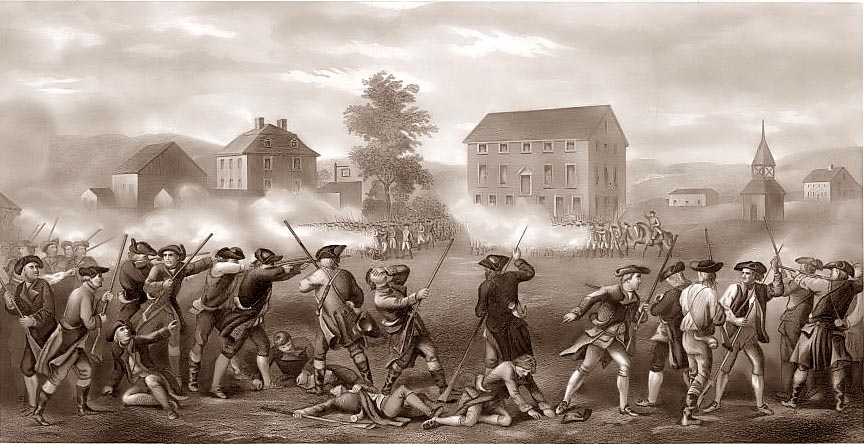
Battle Of Lexington and Concord
Suscribirse a:
Entradas (Atom)


